Senate Banking Hearing
Combating Money Laundering and Other Forms of Illicit
Finance: Regulator and Law Enforcement Perspectives on Reform.


We envision a future where AI innovation and societal trust advance in unison, built on a global standard of mature oversight governance and a foundational commitment to communal responsibility.
Our mission is to mature AI oversight governance by turning principle into practice. Through expert-led education, we equip leaders across industry, policy, and academia to establish the oversight programs, accountability structures, and assurance practices that embed communal responsibility into AI governance at the enterprise level.


The AI governance market is crowded with frameworks, toolkits, and committee charters. Most focus on
managing AI technology: model validation, bias testing, data lineage, operational controls. That work matters, but it is not what boards are accountable for. Courts, regulators, and investors are asking a different question: Does a functioning oversight program exist?
This is the question the Think Tank is built to answer. A committee is not a program. A framework is not a program. A set of controls is not a program. The program is the governance. It is the functioning institutional capability, with defined decision authority, risk and opportunity intelligence, escalation pathways, assurance, and continuous learning, that enables the committee to oversee, the framework to function, and the board to demonstrate it fulfilled its duty of oversight.


AI is redefining how regulated industries create value, serve customers, and compete. Organizations that do
not build the institutional capability to govern AI with confidence face a dual risk: strategic substitution by
faster-moving competitors and expanding fiduciary liability from regulators and courts. The question is not
whether to act on AI, but whether leadership has the institutional capability to make informed decisions at
speed

To address this crisis, the AI RegRisk™ Think Tank was formed—not by theorists, but by the architects of modern governance. Our authority is built on unparalleled, real-world experience. Our fellows are the senior leaders who have shaped and enforced regulations from within institutions like the Federal Reserve, the SEC, and HHS. This depth of practical knowledge allows us to provide guidance that is both visionary and grounded in the realities of execution.

This practitioner-led expertise is housed within a U.S.-based, 501(c)(3) non-profit organization. This charter is fundamental to our mission. It guarantees our objectivity and allows us to serve as a trusted, unbiased resource for all stakeholders. Our role is not to lobby for specific rules, but to provide the foundational intelligence that enables sound policy and responsible innovation. We believe oversight governance must be elevated from a compliance afterthought to a first principle of leadership, and that education is the only sustainable path to get there.
As a 501(c)(3) non-profit, the Think Tank is funded through a combination of program fees, institutional sponsorships, and philanthropic support. Our independence is guaranteed by our nonprofit charter: sponsors support our mission but do not influence our findings or recommendations. We welcome partnerships with organizations that share our commitment to advancing the standard of care for AI governance in regulated industries.
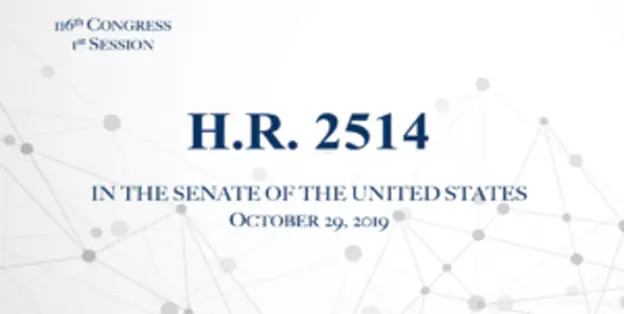
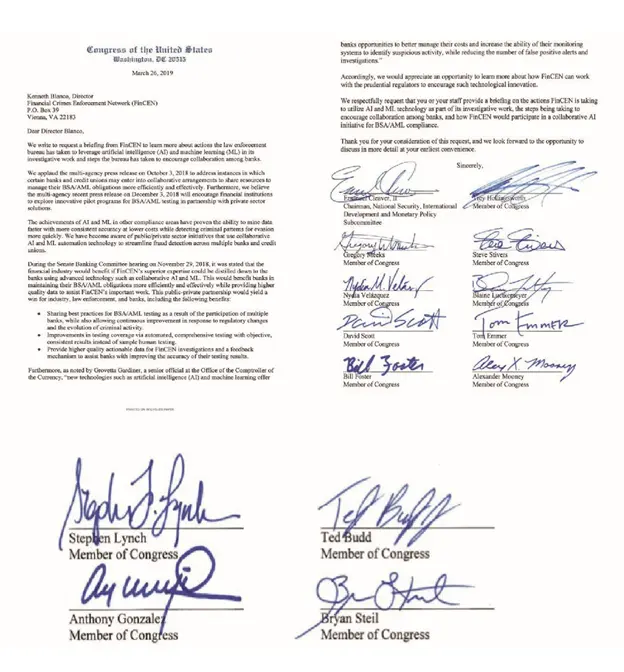
The AI RegRisk Think Tank began in 2018 by advising Congress on modernizing anti-money laundering (AML) practices through artificial intelligence. In collaboration with the Senate Banking and House Financial Services Committees, we recommended AI-driven enhancements to detection, reporting, and compliance efficiency. These recommendations helped shape the COUNTER Act (H.R.2514), one of the most significant AML reforms in recent years.
This early success established the Think Tank as a trusted advisor on AI governance and regulation—laying the foundation for our ongoing mission.
COUNTER Act – H.R.2514 (116th Congress)
Congressional letter to FinCEN (3/26/2019)

Our authority is built on unparalleled, real-world experience.
© 2026 AI RegRisk Think Tank, a 501(c)(3) Non-Profit Corporation. All Rights Reserved.