About us

Our Vision

We envision a future where AI innovation and societal trust advance in unison, built on a global standard of mature oversight governance and a foundational commitment to communal responsibility.

Our Mission

Our mission is to mature AI oversight governance by turning principle into practice. Through expert-led education, we equip leaders across industry, policy, and academia to establish the oversight programs, accountability structures, and assurance practices that embed communal responsibility into AI governance at the enterprise level.


Our Distinguishing Approach: The Defensible Program

The AI governance market is crowded with frameworks, toolkits, and committee charters. Most focus on
managing AI technology: model validation, bias testing, data lineage, operational controls. That work matters, but it is not what boards are accountable for. Courts, regulators, and investors are asking a different question: Does a functioning oversight program exist?

This is the question the Think Tank is built to answer. A committee is not a program. A framework is not a program. A set of controls is not a program. The program is the governance. It is the functioning institutional capability, with defined decision authority, risk and opportunity intelligence, escalation pathways, assurance, and continuous learning, that enables the committee to oversee, the framework to function, and the board to demonstrate it fulfilled its duty of oversight.

Our Story

The Oversight Governance Imperative

AI is redefining how regulated industries create value, serve customers, and compete. Organizations that do
not build the institutional capability to govern AI with confidence face a dual risk: strategic substitution by
faster-moving competitors and expanding fiduciary liability from regulators and courts. The question is not
whether to act on AI, but whether leadership has the institutional capability to make informed decisions at
speed

A Response Forged by Experience

To address this crisis, the AI RegRisk™ Think Tank was formed—not by theorists, but by the architects of modern governance. Our authority is built on unparalleled, real-world experience. Our fellows are the senior leaders who have shaped and enforced regulations from within institutions like the Federal Reserve, the SEC, and HHS. This depth of practical knowledge allows us to provide guidance that is both visionary and grounded in the realities of execution.

An Educational Mandate for an Unbiased Mission

This practitioner-led expertise is housed within a U.S.-based, 501(c)(3) non-profit organization. This charter is fundamental to our mission. It guarantees our objectivity and allows us to serve as a trusted, unbiased resource for all stakeholders. Our role is not to lobby for specific rules, but to provide the foundational intelligence that enables sound policy and responsible innovation. We believe oversight governance must be elevated from a compliance afterthought to a first principle of leadership, and that education is the only sustainable path to get there.

How We Are Funded

As a 501(c)(3) non-profit, the Think Tank is funded through a combination of program fees, institutional sponsorships, and philanthropic support. Our independence is guaranteed by our nonprofit charter: sponsors support our mission but do not influence our findings or recommendations. We welcome partnerships with organizations that share our commitment to advancing the standard of care for AI governance in regulated industries.

Background

Advising Congress on AI

The AI RegRisk Think Tank began in 2018 by advising Congress on modernizing anti-money laundering (AML) practices through artificial intelligence. In collaboration with the Senate Banking and House Financial Services Committees, we recommended AI-driven enhancements to detection, reporting, and compliance efficiency. These recommendations helped shape the COUNTER Act (H.R.2514), one of the most significant AML reforms in recent years.

This early success established the Think Tank as a trusted advisor on AI governance and regulation—laying the foundation for our ongoing mission.

COUNTER Act – H.R.2514 (116th Congress)

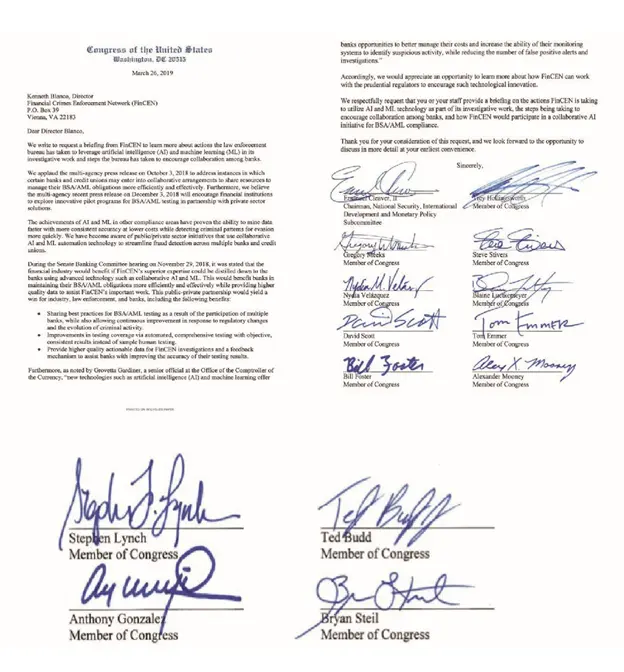
Congressional letter to FinCEN (3/26/2019)

2026

May 2026

Co-hosts Executive Education Seminar with Virginia Tech at the Virginia Tech Innovation Campus, Alexandria, VA.

Releases the PDA AI Oversight Body of Knowledge and The AI RegRisk Oversight Program Program Body of Knowledge v6.

The Think Tank's origins in advising Congress on AI for financial crime detection established the practitioner credibility and regulatory relationships that underpin our work today. From the COUNTER Act to the NIST AI Safety Institute Consortium, our trajectory reflects a consistent commitment to programmatic governance.

2025

February, 2025

Engaged in NIST AI Safety Institute Consortium to develop AI Safety and Implementation Initiatives.

2024

November, 2024

Joins NIST's ARIA project to Assess Risks and Impacts of AI.

August, 2024

Participates in Federal Reserve information-sharing Recommendations Report to combat scams and fraud.

2023

June, 2023

Think Tank members join the Federal Reserve Bank’s work-group on information sharing to define industry-wide protocols to combat fraud.

2022

March, 2022

Members of the Think Tank Participate in the FDIC / US Treasury Department’s competition on Digital Identity Proofing for Remote Customers, winning one of the three categories.

February, 2022

Federal Reserve publishes Synthetic Identity Fraud Mitigation Toolkit to support awareness and prevention efforts across the payments industry.

2021

September, 2021

The Think Tank advocates for a intelligence network that securely shares information about cyber-criminals across a network of participating institutions and government agencies.

2020

November, 2020

Info-sharing network is launched with support of the think tank. The anti-fraud platform is driven by machine learning and features PII-secure data sharing in a unique way for financial institutions, government agencies and regulators to collaborate on digital fraud.

October, 2020

The Federal Reserve appoints the Think Tank to the Synthetic Identity Fraud Focus Group.

September, 2020

The initiative provides comments on FinCEN’s Advance Notice of Proposed Rulemaking (ANPRM) to modernize the effectiveness and efficiency of anti-money laundering (AML) programs.

May, 2020

The initiative’s leadership is appointed to the Massachusetts FinTech Working Group’s Regulatory Innovation Workstream to engage with state-level regulators, including the Massachusetts Division of Banks, and advise on modernization of regulatory compliance.

February, 2020

The initiative brings together financial institutions, Federal Reserve and regulators to pilot collaborative AI solution for synthetic identity fraud detection. Treasury publishes 2020 National Strategy for Combating Terrorist and Other Illicit Financing including AI and Public/Private Collaboration

2019

October, 2019

The think tank briefs Department of Defense on terrorism financing via synthetic identity fraud House passes COUNTER Act HR 2514, including AI innovation Congressman Hollingsworth appointed to AI Task Force Federal Reserve Bank publishes second whitepaper on Detecting Synthetic Identity Fraud

September, 2019

Senate drafts ILLICIT Cash (S.2563) Act to improve laws relating to money laundering and financial crime including innovation The think tank welcomes Congressman Hollingsworth to a discussion on AI

July, 2019

Federal Reserve Bank publishes whitepaper on Synthetic Identity Fraud

June, 2019

Reps. Cleaver, Hollingsworth hold bipartisan briefing with FinCEN on use of Artificial Intelligence (AI) and Machine Learning (ML)

March, 2019

House Financial Services Committee sends letter to FinCEN on the use of collaborative AI to improve fraud detection House Financial Services Committee members send letter to FinCEN

2018

December, 2018

Federal Banking Agencies Issue Joint Statement Encouraging Innovative Industry Approaches to AML Compliance

November, 2018

Senate Banking Hearing on Combating Money Laundering and Other Forms of Illicit Finance. Think Tank prepares questions for Senate Banking Hearing on Combating Money Laundering and Other Forms of Illicit Finance

October, 2018

The think tank meets with members of Senate Banking and House Financial Services Committee to advise on AI for digital fraud detection. Federal agencies issue a joint statement on banks and credit unions sharing resources to improve anti-fraud efficiency and effectiveness

June, 2018

The initiative proposes the collaborative AI concept Senate Hearing proposes innovation to fight illicit finance with AI

February, 2018

The AI RegRisk® Think Tank is established to expand the use of AI in cyber-crime prevention.